
NZSA Disclaimer
In 2016, a quarter of Farmlands voters took part in its director elections. By 2024, turnout had fallen to 5.8%. Last year it was 4.7%, representing just 6% of shareholder capital. Those figures deserve as much attention as any of the ten resolutions going to the co-operative’s AGM in Gore on 24 November.
This year’s notice of meeting contains six shareholder proposals, in addition to four ordinary resolutions. All have stemmed from Farmland’s investment in AgriZero and media scrutiny of the role of Rob Hewett as the Chair of each of those company’s respective Boards.
AgriZero invests in technologies that aim to reduce methane and nitrous oxide emissions from pastoral farming, including a methane-reducing vaccine for livestock and research into lower-emissions pasture. Given the nature of demands from key agriculture customers and markets, this seems a laudable aim in preserving New Zealand’s key role and competitive advantage in the global agricultural supply chain.
Nonetheless, a co-operative gives farmers and growers a direct say in the business that supplies them. It can also be an awkward structure for a capital-intensive business investing for the long-term. The farmer at the shop counter has every reason to want a sharper price today. But as an owner (shareholder), that same farmer needs Farmlands to retain enough earnings to invest for tomorrow.
Shareholder Proposals
At Investors Association New Zealand, we would be unlikely to support any of the six shareholder proposals, although we recognise the validity of discussion surrounding Resolution 8.
Resolution 5 seeks an audit of Hewett’s personal finances and those of any company he is involved with. We agree with the Board when it says it has neither grounds nor authority for such an inquiry.
Resolution 7 would bar Farmlands directors and its chief executive from holding any other directorship.
Consider what that would mean for Will Clarke, the South Otago farmer whose reappointment is also on the ballot. Being a director of his own farming company would disqualify him from helping govern his farmers’ co-operative. We can’t help noticing that the proposal was brought by Ian Harwood, himself a director of his own farming company (Harwood Ag Limited). The precedent set would likely have significant impacts for other co-operatives.
At a broader markets level, while Investors Association has plenty to say about over-boarding, we would be concerned at the precedent set if directors were only allowed to hold one directorship.
Three proposals concern Farmlands’ $1 million, three-year commitment to AgriZero. Resolution 6 seeks to reverse it and hold a referendum, with the shareholder statement questioning the (irrefutable) science associated with climate change.
Resolution 9 asks the Board to explore a commercially reasonable exit from AgriZero and report back within three months. The latter gives directors more discretion, but both run up against a binding agreement. We agree with the Board when it says withdrawal would incur costs and could compromise access to future products that some farmers may want to buy.
Resolution 10 has improved since the original notice. The revised wording expressly preserves Farmlands’ ability to make, sell, distribute and promote products. As it was written originally, the Resolution would have prevented Farmlands from investing in its day-to-day business operational requirements, raising questions around the agency relationship between shareholders and their directors.
Nonetheless, it would still require a 75% shareholder vote before further investment in AgriZero or businesses principally concerned with the specified livestock methane treatments.
We see little merit in writing that restriction into the co-operative’s rules; as noted earlier, the ability of the agriculture sector to manage and measure emissions to meet the demands of global customers is an imperative, not an option.
Even if individuals disagree with climate science at a personal level, their role as shareholders is very different. It is in the company’s interests to play a role and derive value from improving farm emissions. Were Farmlands to have independent shareholders, they would likely encourage directors to examine opportunities for growth investments (like AgriZero).
Shareholders can reasonably expect directors to explain the commercial return on this investment and hold them to account for what it delivers.
Resolution 8
Resolution 8 asks shareholders whether to remove Hewett as a director with immediate effect. The proposer’s case centres on his chairmanship of both Farmlands and AgriZeroNZ, and the potential for conflict of interest.
Issues related to conflicts of interest are real, and are always a key focus of our work. Nonetheless, Board’s are acutely aware of this also. Farmlands are clear in stating that it was aware of Hewett’s conflict of interest, with Hewett playing no part in the investment decision-making in AgriZero by Farmlands.
Fair enough.
But there is one further issue for shareholders to consider, ironically enough not mentioned by either the company or the proposing shareholder. Farmlands’ own notice lists Hewett as chair of WoolWorks, Bremworth, Hilton Haulage, Fern Energy, Rewiring Aotearoa and AgriZeroNZ. Add Farmlands itself, and that is seven Chair roles, alongside directorships at T&G Global and Southern Waters.
A Chair’s workload is hardest to predict precisely when shareholders most need them. If two of those businesses need their Chair on the same morning, which one gets him? Investors Association that it is this issue that should be top of shareholder’s mind in making their decision on resolution 8, rather than the (managed) conflict of interest applicable to Hewett as a result of his Chair roles.
Future succession
The Board discusses both its succession plan and its skills matrix in the material it has provided to shareholders. It says that if both Hewett and Clarke go, seven of its nine directors will have served a year or less by the end of 2027, thereby removing the institutional knowledge critical to any organisation.
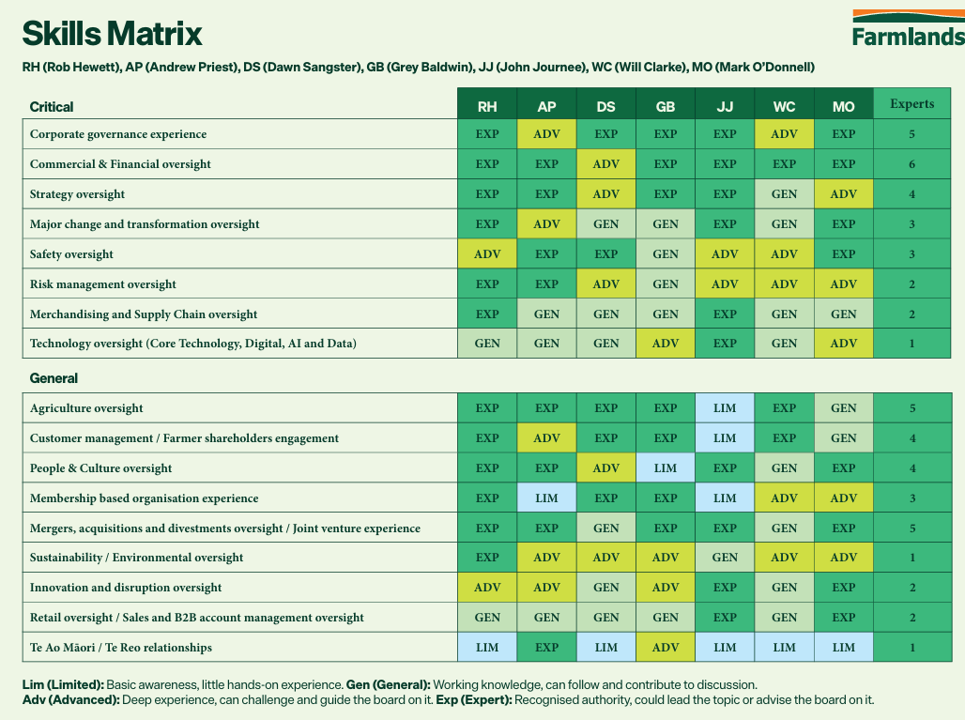
That prospect also raises further questions about the Board’s actions to plan for a managed succession.
There is little doubt Hewett possesses the leadership skills relevant to the agricultural sector. It is perhaps one of the reasons why he is in such demand; although given the leading role of New Zealand in agriculture, it is difficult to accept that there is any significant governance capability gap across the sector.
Regardless, before asking owners to ratify Hewett for another three years under Resolution 3, shareholders should question the Board (and Hewett) as to it assessed his capacity, what time Farmlands expects of its Chair and whether he intends to relinquish any other roles. Those answers matter more to both votes on his future than anything to do with AgriZero.
Tail wagging the dog
Given the incredibly low voter turnout history, it begs the question as to exactly how many shareholders will have a say in the answer.
Low turnout has already changed how Farmlands is governed. Last year, shareholders approved a rule change allowing the Board to appoint shareholder directors, subject to ratification at the AGM. This year it used that power to re-appoint Rob Hewett and Will Clarke. Shareholders still get the final say, provided they exercise their right to vote.
An organised shareholder is perfectly entitled to bring proposals to a meeting. When most owners sit out the vote, however, a proposal can carry considerably more weight than its support across the co-operative would suggest.
Transparency and engagement
For Investors Association, it highlights why most Directors thrive on shareholder engagement, and the questions they face at company meetings. Constructive challenge, new perspectives and shareholder discourse create opportunity for any company.
Farmlands may use the events of 2026 as a lightning rod to both improve engagement with shareholders and create transparency into the core governance processes operating within the business, including conflict of interest management processes.
We hope they do.
But shareholders should also reflect on their role as shareholders. Separate your role as a shareholder from personal opinions and make sure you engage.
Whatever your view of AgriZeroNZ or Rob Hewett, exercise your vote. Eligible shareholders can attend at the James Cumming Community Centre in Gore or online at 6.30pm on Tuesday 24 November. Proxy and company representative appointments close at 6.30pm on Sunday 22 November. The shareholders who put these proposals forward have made their views clear. The rest of Farmlands’ owners have until Tuesday night to make theirs count.