

NZSA Disclaimer
With Americans voting in congressional midterm elections on November 3, investors may hear a familiar claim: US stocks tend to rally around these elections. The historical numbers are certainly eye-catching. But do they offer a reliable way to beat the market?
For New Zealanders and Australians, this is more than an American political curiosity. US shares make up an important part of many KiwiSaver, superannuation and other investment portfolios. What happens on Wall Street affects retirement savings on both sides of the Tasman.
An impressive historical pattern
Midterms take place halfway through a US president’s four-year term, when voters decide who controls Congress. Previous research by scholars from the University of Canterbury shows that the S&P 500 gained nearly 25%, on average, across the final quarter of a midterm election year and the subsequent two quarters, with positive returns in roughly nine out of ten such periods. That contrasts sharply with the market’s performance in other periods.
The pattern has long attracted attention among investors and market commentators. But strong historical averages don’t guarantee future gains.
Why might elections move markets?
One possible explanation is political uncertainty. Ahead of an election, investors face uncertainty about the balance of power in Congress, its implications for future tax and spending policies, and the likelihood of legislative changes. Once the votes are counted, some of that uncertainty is resolved, regardless of which party gains seats. A study published in the Journal of Financial Economics indeed found higher equity premiums, stronger mutual fund inflows and greater real investment growth following US midterms, alongside lower Treasury premiums. These findings are consistent with markets responding to reduced political uncertainty.
The Catch: higher returns do not always mean better investments
A recent study by Anderson, Bialkowski and Wagner examined monthly returns across 49 US industries from 1926 to 2022. At first glance, the same appealing story is shown. Most industries recorded higher returns around midterm elections, time after time. But the picture changes when you account for the broader stock market and standard measures of investment risk. The apparent advantage largely disappears, and the difference is striking: 39 of the 49 industries showed significantly higher returns around midterm elections, but only three retained this advantage after accounting for market-wide movements and other common investment risks (see figure).
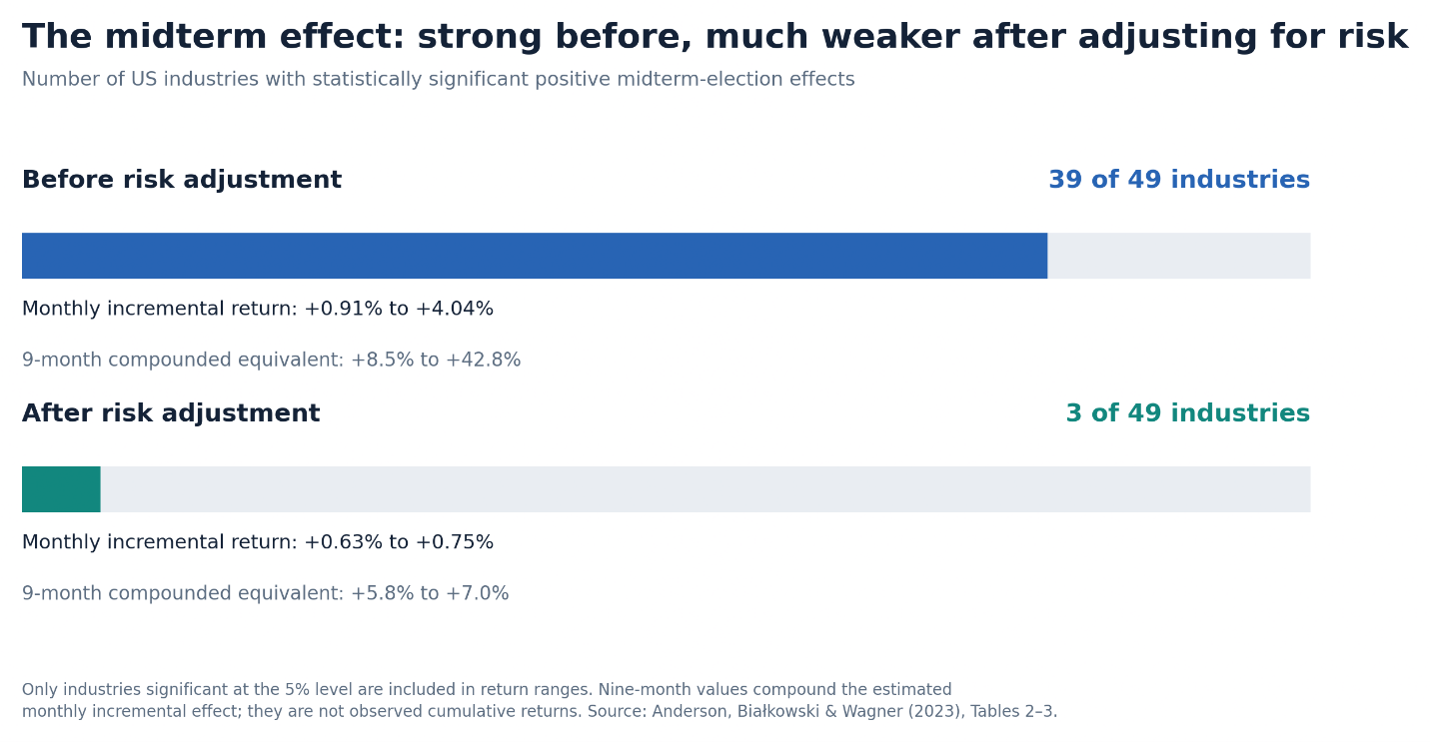
Why does that distinction matter? Suppose technology stocks rise strongly during a broad market rally. Their gains may look impressive in isolation, but they are not evidence of a special election-related opportunity if those returns can be explained by their exposure to market risks.
The findings suggest the midterm effect is primarily a market-wide risk story, i.e. investors may earn higher returns, but mostly as compensation for bearing systematic risk rather than for identifying winning sectors.
What should investors do?
For KiwiSaver members and anyone holding US shares, the lesson is not to ignore American politics. Election outcomes can affect industries, expectations and asset prices, while exchange-rate movements can further alter returns in New Zealand dollars. Of course, one needs to be cautious about turning a historical pattern into a trading strategy. Buying shares because midterms are approaching, or switching into sectors expected to benefit from one party’s success, may add risk and trading costs without delivering reliable outperformance. Furthermore, given the extreme polarisation of the US political landscape, the 2026 midterm elections may do relatively little to reduce political uncertainty compared with previous election cycles. The market slump following the 1930 midterms during the Great Depression, the dot-com crash, and the post-COVID rally also show how economic forces can overshadow electoral patterns. For this year’s midterms, AI-driven investment, geopolitics, monetary policy and the current bond market may ultimately matter more than the election outcome.
Moritz Wagner
References
Kam Fong Chan and Terry Marsh, 2021. Asset prices, midterm elections, and political uncertainty. Journal of Financial Economics, 141 (1).
Warwick Anderson, Jędrzej Białkowski, and Moritz Wagner, 2023. Midterm elections and stock returns. Finance Research Letters, 55 Part A.
Jedrzej Białkowski, Aynaz Nahavandi, 2019. Midterm elections’ stock market surge: an unintentional gift from US politicians. The Journal of Wealth Management, 21(4), 76–84.