

NZSA Disclaimer
Paul McBeth is the editor of The Bottom Line and Curious News, and previously worked at BusinessDesk for 15 years.
Government debt is getting more expensive, and it’s not just about inflation.

Bonds are one of the trickiest things to wrap your head around in financial markets.
They should be easy given whoever’s borrowing the money offers to pay a fixed rate of interest over a set period. Most people tend to understand how a term deposit at the bank works.
Where it starts to test the grey matter between your ears is when the price moves, and with it the effective interest rate you earn – what’s dubbed the yield.
And to make matters even harder, the yield moves in the opposite direction to the price; if someone’s only willing to pay 90 cents in the dollar for a 5% interest rate, or coupon, they’re getting a current yield of 5.6% plus the extra 10 cents of capital gain if they hold the note to maturity.
Feel free to collect your thoughts here.
So why are we diving into the dark arts of fixed interest markets?
You’re going to roll right over this one
Well, it’s hard to ignore them in the past month, where bond traders have been making their discontent known, with the yields on US 30-year treasuries pushing up to 24-year highs, British 30-year gilts climbing above 6% for the first time since 1998 and the spread between French and German government bonds at its widest since the European sovereign debt crisis in 2011.
Even New Zealand’s humble 10-year government bond climbed above 5% for the first time in nearly three years.
US yields have been moving higher alongside oil prices as the US can’t seem to leave its conflict with Iran alone, with each side doing its best to antagonise the other every few weeks or so.
That, of course, has bond traders betting central banks will keep hiking interest rates to see off the inevitable second and third round inflation effects that eventually emanate from an energy shock – even if their blunt instrument does little to address supply-side issues.
However, US inflation-linked securities haven’t been rattled as much as their nominal peers, with the breakeven – the gap between the inflation-linked bond and its nominal equivalent – up a more modest amount.
That’s more a case of bond traders telling governments that they’ll have to pay more to borrow money for longer periods of time, with growing unease about the way politicians are managing their books, and the competing demand for capital coming from the billions of dollars that are needed to help finance the artificial intelligence build-out.
I’ve got your number
The piper eventually has to be paid when you’re running wars in the Middle East or overseeing fiscal deficits for decades on end.
As Craigs Investment Partners investment director Mark Lister says, maybe it’s about time investors demanded a higher return on some of those longer-dated bonds – 5.6% before inflation doesn’t seem too hefty a price to ask when your money’s locked in for 30 years.
To be fair to New Zealand, the spike in domestic government bond yields hasn’t been as severe as some of those major economies we like to compare ourselves to, and the breakeven gap with our inflation-linked bonds has widened in recent months.
It seems local bond traders are still bothered by the prospect of domestic inflation taking longer to get back to the Reserve Bank’s 2% midpoint of its target inflation band, rather than fretting over the inevitable mess someone’s going to have to clean up when the nation’s appetite to spend catches up with it.
That’s future New Zealand’s problem.
In the here and now, the near three-year high on New Zealand 10-year government bonds touching 5.15% washes out at a miserly real return around 1% after the latest inflation data, but that’s a different measure from the 2.8% real yield being priced into inflation-linked bonds.
You’ve got a little worry
If the Reserve Bank gets on top of inflation, those returns on the nominal bonds improve, with the linkers pricing in a real return closer to what investors were accustomed to before the post-GFC era of quantitative easing.
Little wonder that the likes of the fixed income team at Harbour Asset Management have preferred inflation-linked bonds in recent times – especially with less than $1 billion of new linkers coming to market in the current fiscal year.
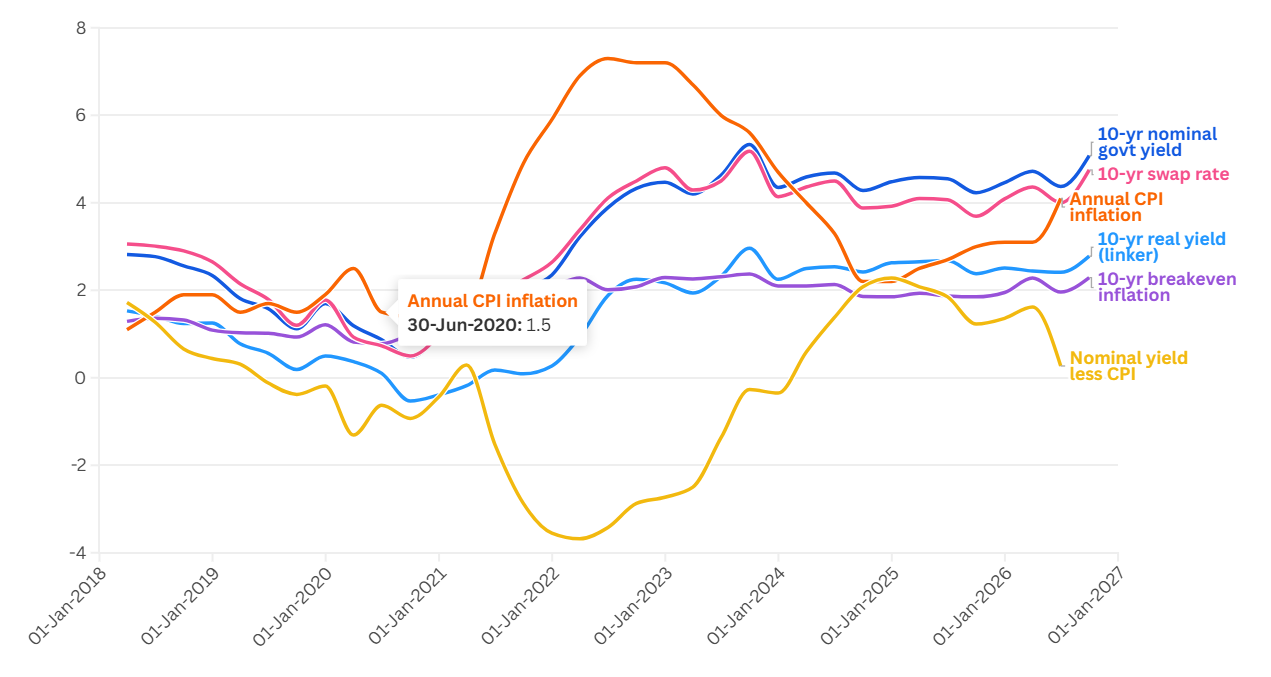
Chart created in Flourish with data from Iress, RBNZ and Stats NZ, and compiled by Claude Opus 5.5.
And it’s not just government debt. The NZX’s debt market has also seen investors demand a higher yield.
Across 100 or so fixed-rate bonds, the median corporate yield rose 36 basis points in September – largely in line with swap rates and a touch more than government bonds, which will be in shorter supply after the government trimmed $15 billion from its borrowing programme over the next four years.
It’s more a case of less Crown paper being on offer than investors souring on corporate credit as shown by the BNZ lifting a $100 million five-year bond offer to $1.25 billion on the back of oversubscriptions.
That’s the sort of offer that can soak up demand in a thinly traded market, where investors tend to hold their bonds to maturity. Still, a few movements in September stand out.
Who dares to cross your threshold
Ryman Healthcare’s 2032 bond yields jumped about 55 basis points in the month, with its margin to the relevant swap rate widening by 20 basis points.
Bond traders seem just as jumpy about the retirement village operator as equity investors, who are watching the shares down at their lowest level since September 2010 as the sector faces the unenviable task of reimagining itself in a less frothy housing market.
Meanwhile, the yield on Infratil’s December 2028 and December 2030 bonds spiked up faster than its other suite of bonds, coming hot on the heels of the firm’s big investor day in Sydney, where the CDC Data Centres business continued to shine as the jewel in the crown. It might be the picks and shovels of AI, but financing the boom isn’t quite as sexy as it was at the start of the year.
The thing about rising interest rates is that they tend to become something of a headwind for equities by making those less risky alternative investments that little bit more attractive.
It also ups the stakes for ambitious companies wanting to do things by making debt financing a little more expensive while lifting the return investors should demand from equity.
To put that hurdle in perspective, Forsyth Barr’s research team estimates a forward median cash dividend yield of 4.1% in the universe of 64 companies it tracks, ranging from as high as 10.2% for Sky Network Television down to zero for the 13 or so firms it covers that aren’t spitting out cash returns. That’s against a five-year average of 4%, or a historical average of 4.8%.
Getting a 5.1% yield on the supposedly risk-free 10-year government bond is putting a lot of pressure on rising share prices to do the heavy lifting. Especially given the S&P/NZX 50 index is barely up 1% so far this year while the S&P/NZX all index has dipped 1.8%, with small- and mid-caps feeling the brunt of the very slow recovery.
Sure, shares offer the prospect of earnings growth and capital gains that a government bond doesn’t, but those rising rates will demand a bigger return for someone willing to take on equity risk.
New Zealand’s bond market might not be groaning like some of the sleeping giants overseas, but it’s definitely humming a familiar tune. The risk-free rate is well and truly back on investors’ radars – and companies will need to bear that in mind when making their pitch for funding.